
The bobbin they dotted
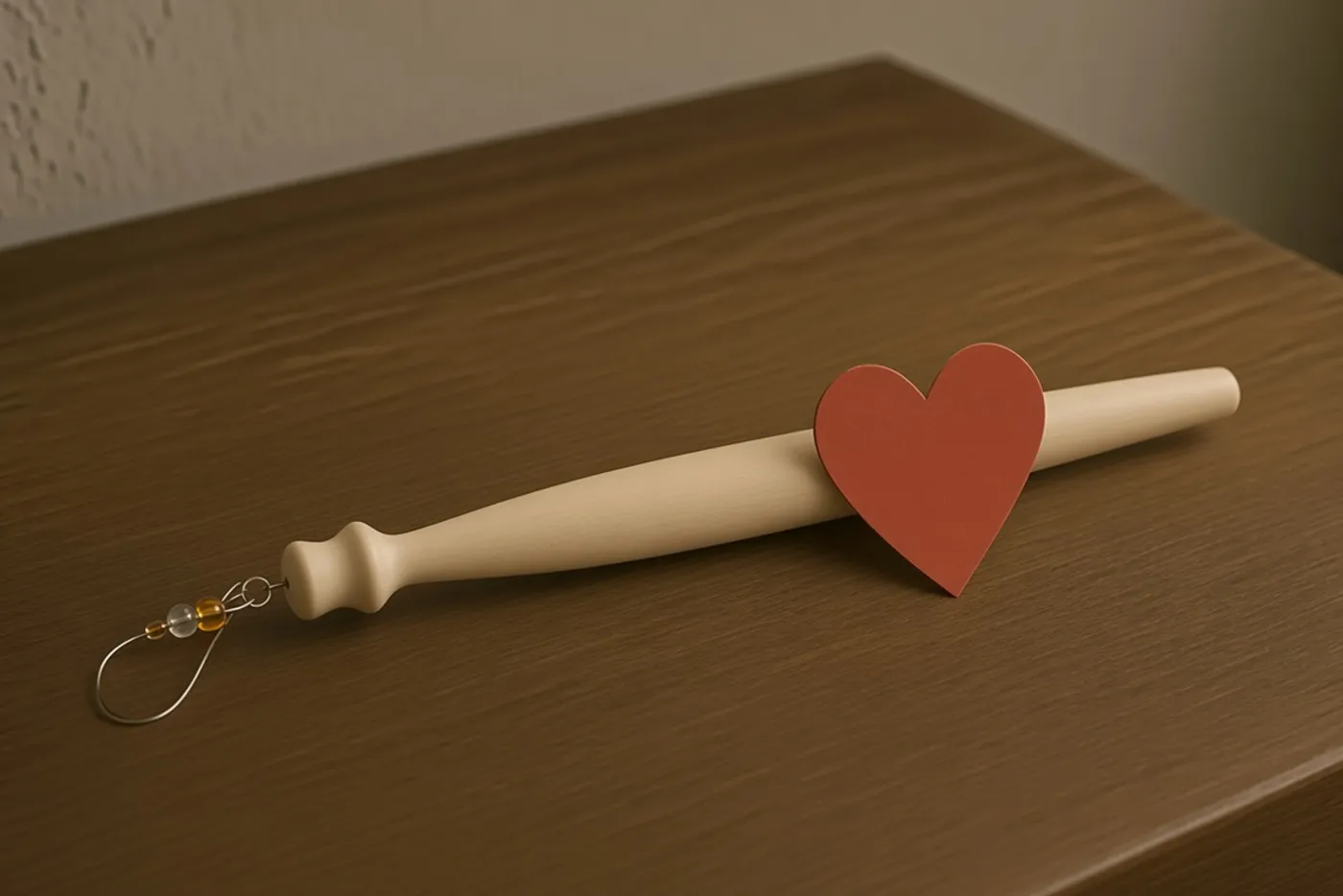
Around the middle of the nineteenth century a bone bobbin was drilled with a sentence, and the dots were filled with red. It tells her to kiss him quickly, because her mother is coming.
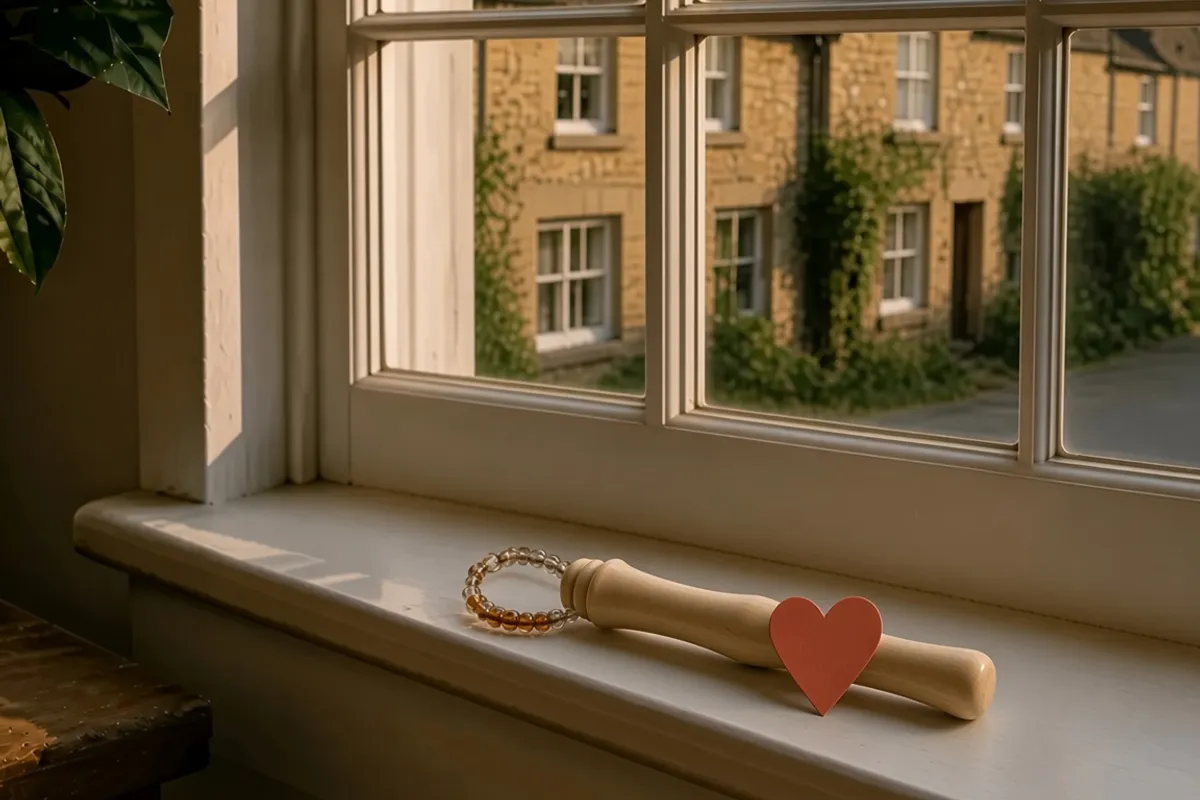
A bobbin carried the thread for bobbin lace. In the English East Midlands the bobbins were slim, of wood or bone, and a loop of glass beads hung from the tail so the thread stayed taut on the pillow. The Cowper and Newton Museum in Olney, Buckinghamshire, says a bobbin of that kind is usually about ten centimetres long. The shank, the part held in the hand, had room for a name or a sentence. The letters were dots, drilled in and filled with red, black or blue. Wooden bobbins usually stop at a Christian name. On bone, a surname would fit, or one short line.
One bone bobbin at that museum dates from about the middle of the nineteenth century. The museum says bone for these bobbins was often supplied by the local butcher, that a bone bobbin cost more than a wooden one, and that this one was probably made by a professional and sold for cash. The thread wound on a long neck of about two centimetres, between a small knob and the shank. Nine glass beads hang from the tail on brass wire: two pairs of round brown beads, two pairs of smaller square-cut beads of clear glass, and one larger Venetian enamelled bead in the middle. On the shank the dots read “Kis me quick my mome is comin”. Kis is kiss. Mome is mum.
The museum says lines of that kind were ordinary enough to be bought. “To my love.” “Love be true.” “Love don’t be falce.” Falce is the spelling. A name still fitted, and it did not have to be a sweetheart’s. At the Victoria and Albert Museum, number T.21-2004 is a bone bobbin with red and clear glass beads. The inscription reads “Sarah Wildman born Oct the 14 1827”. The catalogue dates the bobbin to about 1827. Nothing else is said about her. Another, numbered T.125-1987, is turned wood of the Downton type, made in Wiltshire in the nineteenth century. It is 8 centimetres long, 3.25 inches, with a single long neck, a pointed shank and a spiral cut into the wood. The inscription, filled with red and black, reads “AC LOVE YOUR LEANING”. Fine cotton is still wound on it. Mrs Gwendolen Lethbridge gave it to the museum. Mrs Kate Martin of Redlynch had given it to her in 1905. The catalogue does not say what the line means.
Another bobbin in the Olney museum reads “Jack Alive”. The story that goes with it is of an illiterate lacemaker at Lavendon, a mile or so from Olney, at the end of the nineteenth century. Her son Jack was a sailor. Wherever he went he had a bobbin made and sent it home. When it arrived, she knew he was still alive. She did not have to read the two words. The bobbin was what she had been waiting for.
A bobbin has room for a name or one sentence. The sentence sat in the hand, on the pillow, through the work. The Olney bobbin asks for a kiss before her mother comes in. The bone has kept it.